The Moments Families Remember Most: Inside Calvary’s Therapeutic Recreation Program

A husband and wife, speaking with one another in a way they have not in weeks, sharing how many years they have been married. A patient who rarely speaks, tapping her toes to the music. A shared glance. A knowing laugh. A moment of recognition, connection, and renewed quality of life.

This is part of everyday care at Calvary Hospital.

For more than 125 years, Calvary has cared for patients with life-limiting illnesses and supported the people who love them. That care extends beyond medical treatment. It includes creating meaningful moments for patients to engage, participate, remember, and connect.
The Numbers: First Quarter 2026

  • 900 patient visits to therapeutic recreation programs
  • 502 family members who joined them
  • 141 individualized memory care visits for patients with dementia
  • 7 days a week of programming, 365 days a year
  • 23 to 26 days: the average patient stay
  • $0 reimbursed by insurance

A month, on average

The typical patient receives care at Calvary for approximately one month. Some remain longer; many are with us for only a few days.

That limited time gives every moment at Calvary greater purpose.

Calvary’s Therapeutic Recreation department is committed to ensuring that every patient has meaningful opportunities for connection, engagement, and dignity — regardless of diagnosis, cognitive ability, or length of stay. Patients with advanced dementia and other complex needs are fully included, with each activity adapted to meet the individual where they are.

A shorter stay must never mean a lesser experience. Our mission is to help every patient participate as fully as possible and receive the greatest benefit from every interaction. At Calvary, that commitment is fundamental to the care we provide.

“We want to make sure that there are programs for everyone, no matter how long they are here, so that everyone’s quality of life can be lifted to its maximum capability,” says Stephanie Mastropaolo, who directs Therapeutic Recreation, Music Therapy, and the Family Care Center. She has been at Calvary for 21 years.

The patient population changes every day, and individual needs can shift from one hour to the next. A patient who feels well in the morning may require greater support by afternoon. Family members who visit regularly may be unexpectedly pulled away by other responsibilities.

Therefore, each patient’s care plan must remain flexible. Each day, the Therapeutic Recreation team adapts in real time, responding to changes in condition, availability, and ability so that every patient can participate in the ways that matter most to them.

What the program actually looks like

On paper, the weekly calendar reads like a community center: arts and crafts, bingo, jewelry making, ceramics, movie days, comedy days, live music. Live performance happens at least weekly, often twice, ranging from opera to classic rock. Calvary works primarily with two organizations, Music That Heals and EnoB, with at least four performances a month made possible by an anonymous gift known as the Thrive Grant. Patients who cannot leave their rooms can watch on the in-house television channel.

Then there are the encounters no one expects. One memorable recent visitor was a 125-year-old tortoise; born in 1901, this unlikely visitor provided more joy than we ever anticipated as patients and families lined up to take pictures with it.

A volunteer now runs a Luna Moth program, hatching the large green moths from their cocoons and carrying them from room to room for patients. One patient asked the volunteer to leave the moth at her bedside. “I just want to stare at it some more,” she said.
Two therapists, four floors, every morning walk their floors, checking in with each patient. How are you feeling? Can you come down today? Should I come back this afternoon?

The staff also makes daily room visits that never appear in the statistics. A therapist might sit with a patient who cannot join a group, play some music, or do a small craft project one-on-one. Those visits are documented in patient records but not counted in program totals. The numbers understate the reach.

The newest formal addition is the Sunday memory care program, dedicated entirely to one-to-one visits with patients who have dementia. The work is individualized down to the person. One patient, a former plumber who had lost most of his ability to communicate, lit up when his therapist brought him a set of PVC pipes to assemble. Another, a former blues singer, began singing again when staff played the songs she used to perform.

“Even if they can’t tell you who the person is, they know this is a friendly face, someone I’m familiar with,” Mastropaolo says. “They can still make bonds and still be provided with comfort.”

Richard and Francine

The last gift Richard ever received was a Beanie Baby. He won it at bingo at Calvary in the final weeks of his life, while his wife, Francine, watched him laugh and hold his prize.

Richard was 84. Years of decline had left him using a wheelchair, unable to swallow on his own, and struggling to speak. At Calvary, Francine found herself focusing less on what he could no longer do and seeing more clearly what he still could. He made ceramics and jewelry, including a personalized bracelet with Francine’s name on it. He liked to sit in the sun-washed atrium and watch planes cross the sky.

Francine visited every day for six weeks. She called it “a long goodbye.” After Richard died in the fall of 2025, she returned to Calvary several times and made donations to the program. The time there, she said, had been therapeutic for her, too.

She still wears the bracelet. She still has the Beanie Baby and the blanket he won the same way. She keeps the blanket on her couch and wraps herself in it when she misses him.

Music as Medicine

Separate from the entertainment calendar, Calvary employs two licensed music therapists, one a classical vocalist and guitarist, the other a pianist, who work bedside with patients too ill to attend programs. This is clinical work, not entertainment. Published research has associated music therapy with reduced pain levels and decreased use of pain medication, which can leave patients more alert and more able to engage with their families.

The therapists also do legacy work. Allison, who has been with Calvary for 15 years, recently wrote an original song with a patient. When patients cannot sing their own compositions, she composes and records the music and sends it to the family, so they can keep their loved one’s voice forever.

Caring for the people at the bedside

Stephanie Mastropaolo also oversees the Family Care Center, which serves families and loved ones keeping vigil alongside patients. Its newly expanded space is located at the center of the building, making support easy to find.

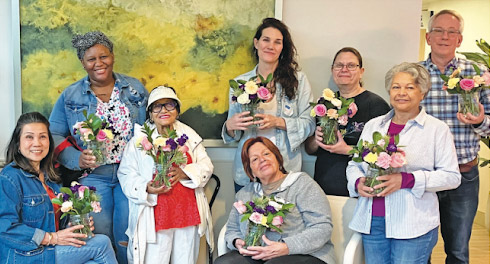
Programming includes Flowers for Healing, progressive muscle relaxation, aromatherapy blending, therapeutic drumming, support groups, a monthly teaching kitchen led by Calvary’s chef, and discussions on anticipatory grief every Monday and Thursday. The schedule is designed to make those conversations available even when a family’s time at Calvary is brief.

Anyone who has spent long days in a hospital knows the toll: the spouse who has not slept, or the daughter moving between work and the bedside, eating whatever the vending machine offers. Ten minutes of respite is not a luxury. It can be what allows someone to keep showing up.

None of it is reimbursed

Therapeutic recreation is not a reimbursable service in any hospital. Every musician, every art supply, every bead, every Luna Moth cocoon at Calvary is paid for through philanthropy and the annual budget the hospital can allot from donated funds. Recent grants have funded the memory care program, expanded the music schedule, and stocked in-room activity kits for patients who want to keep creating on their own between programs.

“Calvary would not be Calvary without these programs,” Mastropaolo says.

In a single quarter, there were 900 reasons to get out of bed, 502 family members making memories instead of just keeping watch, and 141 visits that told a patient with dementia: you are not forgotten, and you are not alone.

Therapeutic Recreation at Calvary Hospital runs 365 days a year and is funded entirely by donors. To support the program, visit calvaryhospital.org/recreation.

The department runs on a small team: two recreation therapists, each responsible for two units, and a recreation technician who preps and facilitates programs. Every morning, the therapists

Therapeutic Recreation Program
Menu